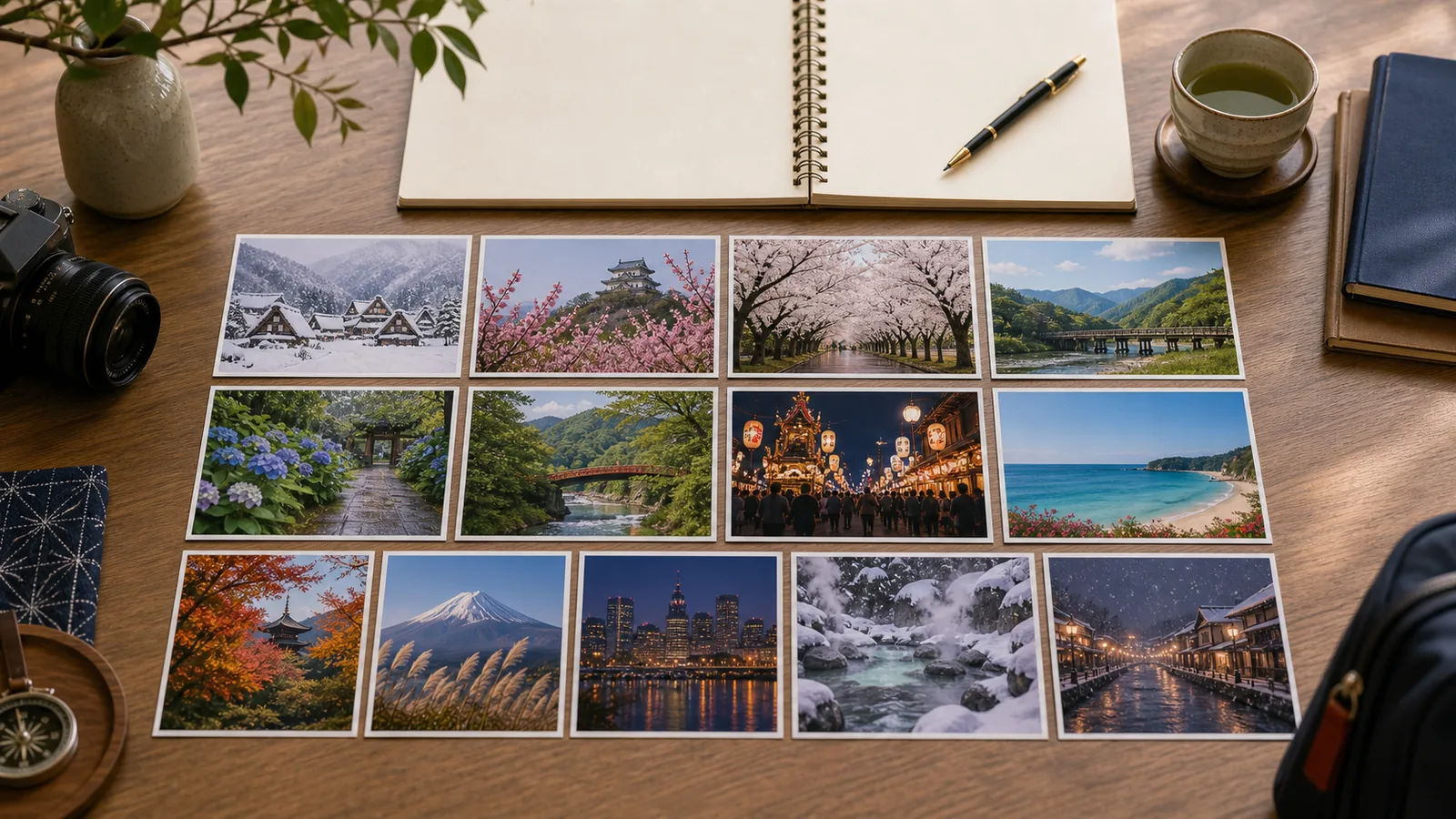
You ask, 「When is the best time to go to Japan?」 The answer — it depends on what you want to see. This article walks through all twelve months in Japan: the weather, the signature events, the pros and cons, so you can reverse-engineer the right month from「what you want to see」.
January — snowscapes plus New Year culture
— Weather: Honshu 5-10 degrees sunny and dry, Hokkaido -10 degrees heavy snow — Events: 初詣 (the first shrine visit of the year, with 3 million people at Meiji Shrine), snow festivals, the Shirakawa-go gassho village light-up, peak ski season — Pros: flights and hotels 30 percent cheaper (except the first week of New Year), a high share of sunny days, the tail end of fall foliage — Cons: most restaurants are closed 1/1-3, New Year crowds, extreme cold in Hokkaido — Suited for: snow lovers, skiers, New Year culture seekers
February — Sapporo Snow Festival and snowy onsens
— Weather: Honshu 5-12 degrees, Hokkaido -8 degrees still snowy — Events: Sapporo Snow Festival (around Feb 4-11), Shirakawa-go snow night light-up, the quietest snow days of the year in Tokyo — Pros: ice sculptures, reliable ski snowfall — Cons: cold, short daylight — Suited for: snow festivals, Ginzan Onsen, snow chasers
March — plum blossoms and early spring
— Weather: Honshu 10-15 degrees, cool mornings and evenings — Events: plum blossoms (Kairakuen in Tokyo, Yushima Tenjin), the Hina doll festival, the first cherry blossoms in Kyushu — Pros: thinner crowds, a quiet period before the cherry rush — Cons: spring rain, cherry blossoms not yet open — Suited for: those who want to skip the cherry crowds, low-key Kyoto walking
April — peak cherry blossoms and the Golden Week eve
— Weather: Honshu 13-18 degrees, Hokkaido 5-10 degrees — Events: hanami (Meguro River in Tokyo, Arashiyama in Kyoto, Hirosaki in Tohoku), school entrance season, the cherry front sweeping the country — Pros: spectacular sakura, perfect for outdoor strolls — Cons: after 4/29 Golden Week begins and crowds explode — Suited for: cherry fans, the 4/1-4/20 window
May — after Golden Week, early summer greenery
— Weather: Honshu 18-23 degrees, Hokkaido 13-18 degrees — Events: Sendai Aoba Festival (mid-May), the fresh 「新緑」 (new green) leaves emerging everywhere — Pros: from 5/7 Golden Week ends, crowds stabilize, the new green is beautiful — Cons: Golden Week (4/29-5/5) is strongly inadvisable — Suited for: the post-GW window from 5/7 to 5/31
June — rainy season plus hydrangeas
— Weather: Honshu 22-27 degrees, three weeks of rain — Events: hydrangea (あじさい — Kamakura, Kyoto, Tokyo), the rainy season flower display — Pros: hotels 40 percent cheaper, indoor sights unaffected — Cons: continuous overcast and rain, limited outdoor activities — Suited for: budget travelers, indoor-sight lovers (museums, shopping), hydrangea fans
July — festivals and high heat
— Weather: Honshu 28-33 degrees, high humidity — Events: Kyoto Gion Festival (all month, with Yoiyama on 7/14-16 and 24-25), Tokyo Sumida River Fireworks (the last Saturday of July), Hokkaido as a heat escape — Pros: summer festival atmosphere, perfect for yukata — Cons: brutal heat, daytime sightseeing is hard — Suited for: festival fans, Hokkaido travelers
August — fireworks plus peak heat
— Weather: Honshu 30-35 degrees, feels-like temperature higher — Events: Aomori Nebuta (8/2-7), Tokushima Awa Odori (8/12-15), fireworks across the country, Obon (8/13-16) — Pros: a dense calendar of fireworks, Hokkaido stays cool — Cons: hottest, Obon disrupts transit, regional areas packed — Suited for: fireworks fans, Hokkaido heat-dodgers, Obon counter-strategists
September — typhoon season plus early autumn
— Weather: Honshu 23-28 degrees, Hokkaido 18-23 degrees — Events: Respect for the Aged Day weekend (mid-September), White Dew, the first Hokkaido fall foliage — Pros: comfortable climate, lighter crowds — Cons: high typhoon probability (an average of 2-3 typhoons near Japan) — Suited for: budget-friendly travel, Hokkaido foliage
October — autumn comfort plus early fall colors
— Weather: Honshu 17-22 degrees, the most comfortable month in Japan — Events: Nagasaki Kunchi, early Tohoku foliage, the Sports Day weekend (the second Monday of October) — Pros: ideal climate, peak outdoor enjoyment — Cons: no major drawbacks — Suited for: all-around recommendation, the foliage prelude
November — peak fall colors plus Culture Day weekend
— Weather: Honshu 11-17 degrees, cool mornings and evenings — Events: peak Kyoto fall colors (mid- to late November), Shichi-Go-San (a children’s coming-of-age rite on 11/15), the Culture Day weekend (11/3) — Pros: spectacular foliage, cool weather — Cons: Kyoto weekends jam-packed, 11/3 weekend crowded — Suited for: one of the most highly recommended months (for foliage fans), Kyoto on weekdays
December — illuminations plus early winter
— Weather: Honshu 7-12 degrees, Hokkaido -3 degrees — Events: Tokyo Christmas illuminations (Roppongi, Shinjuku, and others), the end of Kyoto fall colors (early December), osechi preparations — Pros: gorgeous illuminations, the foliage tail plus first snow, hotels cheaper before 12/28 — Cons: 12/29-1/3 New Year is the busiest stretch of the year — Suited for: illumination fans, Christmas atmosphere, New Year culture seekers
Verdict — which month is best?
All-around top pick: October (comfortable climate, early foliage, no typhoons, no weekday holidays) and mid-November weekdays (Kyoto fall colors at peak, avoiding weekends)
Budget-conscious: June (rainy season, hotels 40 percent cheaper) and mid-January after New Year through late February (the cheapest stretch nationwide)
Special cultural experiences: early April (cherry blossoms), July-August (festivals), and late December (New Year shrine visits)
Worst months: the August deep summer (heat plus Obon), Golden Week 4/29-5/5, and New Year 12/29-1/3
Pro tip
The right order for picking a month: first decide what you want to see (cherry, foliage, snow, festivals), then reverse-engineer the month, then dodge the national holidays, then book flights. People who flip this order discover「flight was cheap, I booked, then realized it was Golden Week」. Next time you plan, treat dates as the source of the trip experience — not a variable to tweak after the fact.
Frequently Asked Questions
What month is best for a first Japan trip?
After Golden Week in May, October, and weekdays in November are the most balanced for weather, crowds, and planning.
Which Japanese holiday periods should travelers avoid?
Golden Week, Obon, and New Year holidays are the biggest pressure points for transport, hotels, restaurants, and crowds.
Is rainy season a bad time to visit Japan?
Not necessarily. Plan hydrangeas, museums, shopping, cafes, and onsen, and bring shoes that handle wet pavement.
When should I visit Japan for snow?
Mid-January to February is best for a winter feel. Hokkaido, Tohoku, Nagano, Niigata, and Shirakawa-go are far more reliable than Tokyo.